THE
WORLD FORMULA
Preliminary considerations
Work
in progress (last revision: April 2007)
I. First
Presentation of the System
1. The
main point in chapter V of my book Formale und generative Dialektik
(2006) (in short: FGD) is to propose
the possibility of formulating a World
Formula. In the Dialog together with Walter Rella at the end of this chapter
I here humorous called it the Rella-Swing Formula. However, in FGD
it was there never clearly explicated and discussed. This has to be done now.
The
formula was based on the three Hamiltonian imaginary quaternion-operators i,
j, and k of his “quaternion” with the following properties:
i2
= j2 = k2 = ijk = -1
On this
basis I formulated the World Formula (WF)
in this way:
 = 1. I think here the first
problem will surely be to accept the sixth power of the sixth root of the
Hamiltonian ijk- complex. You would possibly think the fourth power of
the forth root would do better. This was also my first thought concerned with my
working out the idea, and this form of the expression will be discussed below,
too. But as the idea about a WF in FGD
were developed on the basis of my painstaking analyses of the main Marxian
economical concepts, in the course of the discussion with Rella this form
appeared to be too narrow. Our discussion lead to a comprehensive
natural-cultural world picture containing not less than six “spheres” or
“levels” (strictly speaking, in fact Marx, like classical physics, only knew
two such levels). These could be ordered in different ways, which shall be
discussed below.
= 1. I think here the first
problem will surely be to accept the sixth power of the sixth root of the
Hamiltonian ijk- complex. You would possibly think the fourth power of
the forth root would do better. This was also my first thought concerned with my
working out the idea, and this form of the expression will be discussed below,
too. But as the idea about a WF in FGD
were developed on the basis of my painstaking analyses of the main Marxian
economical concepts, in the course of the discussion with Rella this form
appeared to be too narrow. Our discussion lead to a comprehensive
natural-cultural world picture containing not less than six “spheres” or
“levels” (strictly speaking, in fact Marx, like classical physics, only knew
two such levels). These could be ordered in different ways, which shall be
discussed below.
One simple form of ordering these levels could be the following. The
first three could together be called the “natural” ones with level I being
interpreted as the (manifest) quantum level, level II in the classical-physical
sense as the ‘material’ level of matter and movements etc., and finally
level III as the in a primordial sense organismic one the consequence of which
with its higher structuring (cyclical functions, etc.) generating an elementary
form of consciousness (awareness). This could be assumed to exist at least to
higher animals (incl. apes and humans) and as such being necessary for
elementary individual behaviours.
The next three levels, call then possibly the “cultural” ones, would
then be defined as, firstly, the result level of the conscious and purposeful
actions (level IV) thereby in some way also defining essential aspects of the
concept of meaning. Level V based on this previous level, then, would be the
level representing what in the first instance could be called “intellectual”
matters, treating the “use-” and “meaningful” things and thoughts in
abstract ways (through valuations, calculations, etc.). Finally, level VI would
encompass what in a certain equally un-precise wording could be called the
“higher” cultural content of human consciousness (ethics, aesthetic, etc.).
In this way these levels IV-VI together rather represent super-individual,
social and collective matters, in the light of which the human individuals as
such could be defined as socialised individuals. These very first suggestions,
however, are to be essentially substantiated in the following paragraphs. Diese beiden Stücke vielleicht hier rauszunehmen.
2. A
serious problem of this sixth power of the sixth root indicating and uniting
these six levels into one single expression is of course that immediately we
only know 4 roots of 1, just +1, –1, i, and –i , where i
means the imaginary number
 , all of which in the fourth
power make just 1. Therefore in the course of our discussion in my book I
“stated” -i which contains two negatives to be somehow equivalent to
the positive (–i »
+1), this strange chimera of the double negative (as a kind of a double
negation) thereby to be distinguished from both the
“normal” + and the “normal” – , so to say representing their
dialectical unification. Correspondingly I “stated” i in the same way
to be equivalent to the negative. In this way the double negative form -
, all of which in the fourth
power make just 1. Therefore in the course of our discussion in my book I
“stated” -i which contains two negatives to be somehow equivalent to
the positive (–i »
+1), this strange chimera of the double negative (as a kind of a double
negation) thereby to be distinguished from both the
“normal” + and the “normal” – , so to say representing their
dialectical unification. Correspondingly I “stated” i in the same way
to be equivalent to the negative. In this way the double negative form -
 was interpreted positive, the singly negative form
 interpreted
negative.
interpreted
negative.
On the
basis of this “statement” I shall in the following paragraphs propose a
scheme containing the full sequence of the six levels, each one represented by
the operator triple ijk, showing
their mutual connections:
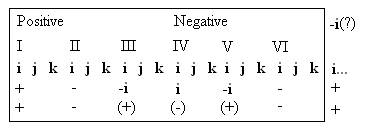
The
second line of this scheme shows the level numbers, the third line the primary
operators i, j, and k, and the fourth
line the immediate signs of +, -, -i
and i of the ijk-triplets in
case. Next to this line these signs are “interpreted” as mentioned in the
sense of the “statements” as + and – . The first three levels together,
call them for instance the “natural” ones, might together be called a
positive group, the last three, call them the “cultural” ones, the negative
group (cf. the upper line of the scheme). But this upper line to the right also
indicates that we in no exact way will return to the very first + ijk-triple;
i.e. the next +i is necessarily to be seen under the aspect of -i (see figure above to the right). Consequently, after each
run-through of the whole group of six triples these must be seen under different
aspects. With indices (signs) characterising not only the respective levels but
the whole frames as well we could describe the first such group or frame
transition in this way: +(-VI)
®
-i(+I); the next in this way then being (reading to the right + as -i):
-i(-VI) ®
-i(+I); and the third, then, in this way -i(-VI)
®
+(+I) – this, presumably, neither to be seen under an
aspect identical with the first mentioned +I. However, our main
discussions will be limited to the system of the six forms contained in the
indicated frame. This in a quite formal way indicates an un-ended possibility of
further evolution.
So we
have to accept the idea that even the first mentioned formula
 =
1 will in fact be seriously questioned. Its unity as a One cannot be really and
exactly, mathematically defined as it would have to be by limiting our
discussion to the “normal” four roots of 1. So here the advertised unity
equation “= 1” does certainly not indicate the truth of an exact identity,
rather – as indicated FGD and also
here in Genus as a Fundamental Dialectical
Category – merely as “non-falsity”. I/We
therefore rather shall propose Rella’s and mine/our primordial World
Formula in the following form:
=
1 will in fact be seriously questioned. Its unity as a One cannot be really and
exactly, mathematically defined as it would have to be by limiting our
discussion to the “normal” four roots of 1. So here the advertised unity
equation “= 1” does certainly not indicate the truth of an exact identity,
rather – as indicated FGD and also
here in Genus as a Fundamental Dialectical
Category – merely as “non-falsity”. I/We
therefore rather shall propose Rella’s and mine/our primordial World
Formula in the following form:
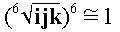
3. This
is a quasi-mathematical expression of an essential and fundamental non-identity
in the light of assumed in-exactly iterative but rather circular way of
functioning, of production and reproduction etc., these being the principal and
general way in which the here so-called “Genera” incarnate the circular (or
spiral) structures of the life functions to be able continually to exist at all.
Each single triplet must in fact express this non-identity in connection with
each single sign shift
ijk
 -1
-1
meaning
at least that neither two adjacent triple pairs (nor triples of the same level;
see below) will ever be exactly identical but modified after the circumstances.
As indicated already in Vorwort (introduction) to FGD and here in Genus, too,
it was made clear that my/our
crucial intention was in this way to break the traditional argumentative logic
connecting exactly identical (in the sense of equivalent) expressions – and
consequently also to break with the high goal of logical and mathematical Truth of calculations, this ideal fiction haunting all “exact”
sciences for more than two millenniums. I
thereby am aiming at replacing the demand of abstract (at best absolute)
Truths by a more concrete and
“worldly” general non-falsity –
this, of course, not meaning to declare all abstract truth-seeking simply false.
On the contrary, it rather raises the decisive question of the real
social-historical preconditions necessary satisfied to develop just such ideas
of Truth.
It
follows from this that neither it will be possible to state what the content or
character of any triplet simply and exactly is so and so merely because
its formal designation is the same as a former one but that is always must be
seen in the light of its specific, ever changing aspects. So, as indicated on
the figure above, we must appreciate the fact that after the full run of all six
triples the next + level will never
be quite identical to the starting + level.
Something new has been generated. Just this idea of principal non-equality is
expressed in the title of my/the
above mentioned book also concerning generative
dialectics; it thereby throws an evolutionary, resp. historical light over
every form of our Genus existence.
In this
way underscoring the essential non-identity does, as mentioned, not exclude
traditional, linear identity arguments in the sense of logic and mathematics. Of
course, Socrates is mortal, and 5 + 7 = 12. You of course also may stay
operating on the same level of the scheme if one of the imaginary operators are
turned into its negative or, better, replaced by its complex conjugate (indicated
by the sign *). In this sense I
in FGD have given different
interpretations of an operator –k (or the complex conjugate of k, k*); so also in this
case, of course, the equation
ijk*
 1
1
will be
valid keeping the sign unchanged on any of the six levels.
On this
basis we must ascertain that our traditional way of linear thinking must –
instead of being the årimary way of scientific thinking – be a consequence of
a historical conditioning in the course of which the abstraction of the very Truth-postulate
by means of some identity argument has been generally accepted. Consequently all
of us naturally operate with abstract concepts in the sense of Plato, Euclid,
Descartes and all their lucid followers. Such ideal concepts being accepted “true”
were primordially an essential part of the ancient “scientific revolution”
commenced by the Greeks. However, we must ascertain that such a way of thinking,
on the one hand as mentioned, is no primordial one, we must assume earlier ways
of thinking following other paths of thought to state necessary “non-falsities”.
But we have also to assume that new ways of thinking as consequences of the
further historical development has come up today and further will come up or
tomorrow as “revolutionary” ones in which – possibly – this circuitry of
argument will be essential for creating new ideologies and styles of science.
To be continued