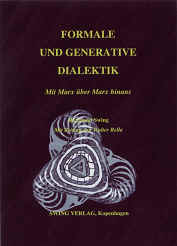
FORMALE
UND GENERATIVE
DIALEKTIK
Mit Marx über Marx hinaus
Raymond Swing
(Kopenhagen, Dänemark)
Mit
Beitrag von Walter Rella (Küb, Österreich)
|
|
FORMALE
UND GENERATIVE Mit Marx über Marx hinaus Raymond Swing
(Kopenhagen, Dänemark)
|
Synopsis
|
Synopsis
in English
|
Dieses Buch versucht – unter der
Bedingung, dass schon ein allgemeiner, spezifisch westlicher
Platonisch-Aristotelisch-Christlicher Denkmatrix vorliegt – diesen Matrix selbst kategorial zu bestimmen.
Dafür
werden als exemplarischer Text, seiner politisch-ökonomischen und
allgemein-gesellschaftlichen Relevanz wegen, ausgewählte Stellen aus Das Kapital von Karl
Marx benutzt, jedoch ohne auf seine konkrete ökonomische Theorien einzugehen.
Dadurch wird gleichzeitig die Marx’sche Dialektik bestimmt und in einer
Weise fortgeführt, die zu seiner Zeit nicht möglich war.
Dabei wird einerseits versucht, die
klassisch-logische Linearität des Denkens durch eine eher zirkuläre Denkweise
zu ersetzen. Diese Denkweise, der auch eine dialektische Wahrheitsauffassung
inhärent ist, wird in der Einleitung kurz begründet. Zum Zweiten wird der
„blinde Fleck“ aufgedeckt, der sowohl die Marx’sche wie auch alle anderen
allgemein-klassischen Denkweisen, darunter z.B. auch die der klassischen
Physik. So wird auch die kategoriale „Schranke“ solcher Denkweisen
bestimmt. Diese „Schranke“ wird exemplarisch bei Marx lokalisiert;
gleichzeitig wird aber gezeigt, wie der Marx’sche Text selbst über diese „Schranke“
hinausweist, wenn bloß die Marxsche Analyse- und Argumentationsform
konsequent zu Ende geführt wird. So kann dieses Buch auch im Sinne einer
allgemeinen Kulturkritik gelesen werden.
Für diese Aufgabe wird eine besondere formale Darstellungsform entwickelt, die selbst einer Kritik unterworfen werden muss, so dass diese zum Schluss ersetzt wird durch einen mathematischen Formalismus, der William Rowan Hamilton entlehnt wurde, hier jedoch in verallgemeinerter Form. So enthält die behauptete kategoriale Zyklizität der entwickelten Denkmatrizes ihre widerspruchsfreie Bestätigung.
Endlich wird in einem Ausblick-Kapitel versucht, eine
möglich reale Entwicklungslinie für den Gegenwart anzudeuten.
271
Seiten. Ladenpreis:
25
Euro oder
250 DKr.
 2006
SWING VERLAG, Kopenhagen
2006
SWING VERLAG, Kopenhagen
Freies Kopierungsrecht ist mit genaue Quellenangabe
von mir gestattet. Dasselbe gilt Übersetzung, graphische und elektronische
Bearbeitung usw. nach Mitteilung
ISBN
87-990876-1-8
Druckerei:
NB/Grafisk ApS, Frederiksberg
Anschrift
des Verlags: R. Swing, Drosselvej 81, Dk-2000-Frb.
This book is trying – in the light of the predominant specific western platonic-Aristotelian -Christian dominated way of thinking – to define this way of thinking categorically.
For this purpose we will use selected texts from Marx´ Capital because of both their political-economic and common social relevance, but without touching on Marx` more concrete economic theories. Thereby the Marx dialectic is characterized as such and is redeveloped in the book in a way, which was impossible at Marx´ time.
In this connection, also the linearity in the classic-logical ways of argumentation will be criticized and replaced by a consequent circular way of thinking, which in itself contains the dialectic’s generative moment. This new way of thinking with its special understanding of Truth will shortly be mentioned in the introduction. Further, the book states the “blind spot” which characterizes all the classic ways of argumentation, including both the Marxian and that of the classical physics. Hereby also the “barrier” of this way of thinking is defined, which in the case of Marx is clearly defined in the light of his famous analysis of commodities. At the same time, however, we see that Marx himself is pointing beyond this “barrier”. You must here only consequently carry through his method of analysis. Thus, the book can also be read as common critique of culture.
To carry through this, the book develops a formal way of presentation, which itself will be subject to criticism. This is finally leading towards a mathematical structure based on thoughts by William Rowan Hamilton, who lived in the first half of the 19th century, but here in a generalized form. The dialectics will thus obtain its quite abstract form of presentation free of contradictions.
Finally it will be tried in an Outlook–chapter – again on the basis of Marx` own texts – to indicate a possible social development today.
271 pages. Retail price 25 EURO
2006 – SWING Edition, Copenhagen